DJTT change of purpose: is an opening balance sheet needed?
Changing to a DJTT self-employed permit? Prepare your opening balance sheet, bank evidence and invested capital before arranging the review.
By Kyle Bouwmeester, Becon-registered bookkeeper
Published
Yes, prepare an opening balance sheet (openingsbalans) when changing your existing residence purpose to self-employment under DJTT. Since April 2024, the IND has stopped requiring an opening balance sheet for a first application, while the balance remains relevant for a change of residence purpose (wijziging verblijfsdoel), checks and renewal, and often for the bank, as explained in my application guidance. For your preparation, keep those application situations separate. Start by identifying that you are changing an existing status before arranging the financial review.
Why does a change of residence purpose need separate preparation?
A change from an existing residence status needs its own balance-sheet preparation, even if you have read about the changed approach to first applications in my DAFT guidance. Which application situation does the guidance you are reading actually describe? Ask that question before using someone else’s document list. Keep your own request clearly labelled as a change of purpose throughout the preparation.
Among Japanese applicants changing an existing residence status to self-employment, arranging the balance review after Chamber of Commerce registration (KVK-inschrijving) is a recurring preparation question. Use that question to organise the work before requesting a review date. Tell the person preparing your balance which registration and banking steps you have already completed. For the official application route, refer to the IND’s self-employed residence permit page.
What should you prepare before the balance review?
My preparation sequence is Chamber of Commerce registration, making bank evidence available, preparing the balance sheet and then reviewing it, following the workflow used in my balance-sheet work. Use that sequence when discussing timing. Ask when to provide the bank evidence and when the draft can be prepared. Avoid choosing a review date without discussing the documents that will be available by then.
In the 12 months to 4 November 2026, 10 people asked me to prepare and sign an opening balance sheet for the IND, including questions about timing and cost, in my administration practice. Put those questions in the same request as your change-of-purpose explanation. Include whether registration is complete and whether you can already provide bank evidence. That gives the preparation discussion a concrete starting point.
For the quotation, I separately identify the fee, value added tax (btw), any additional work and dependence on complete documents in my pricing checklist. Ask for each of those items to be addressed before agreeing on timing. Which work is included in the quoted fee? What still needs to be supplied before preparation and review can proceed?
How do cash, equipment and private withdrawals affect the balance?
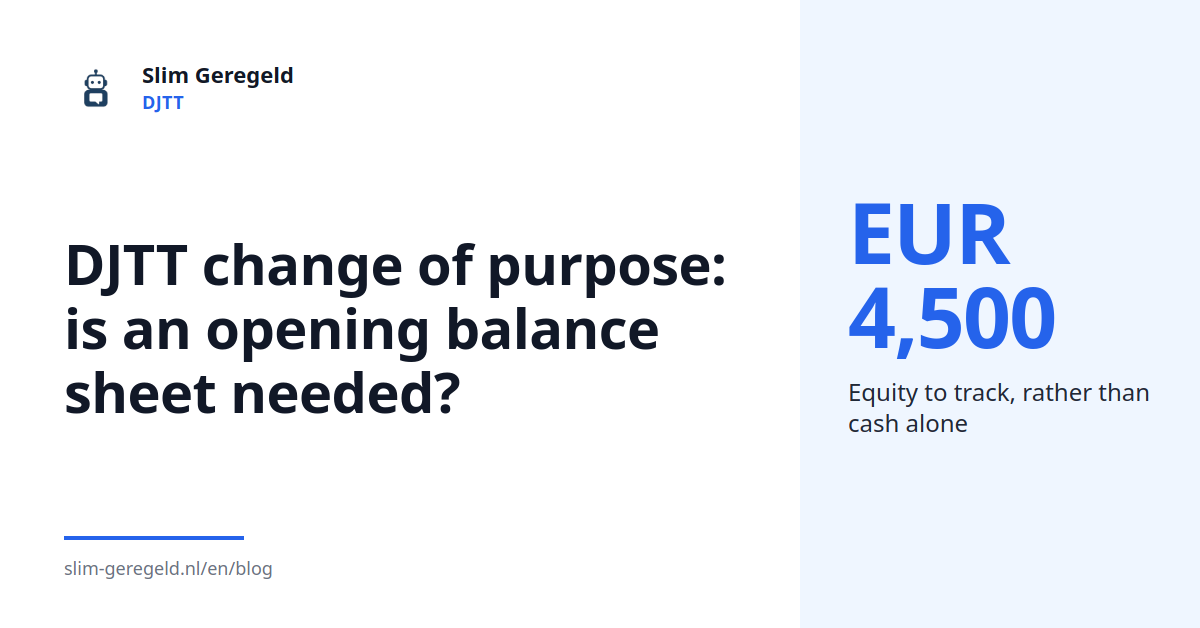
The EUR 4,500 concerns equity (eigen vermogen), calculated as assets minus debts, as explained in my invested-capital guidance. Read the example below with that calculation in mind. Follow the cash column alongside the equipment column. For the equipment purchase, the example assumes the equipment is recorded at its purchase amount and that there are no debts or other movements.
This pattern comes up in several files. A worked example with round amounts:
| Position after each movement | Business cash | Equipment | Debts | Equity |
|---|---|---|---|---|
| Initial capital contribution | EUR 4,500 | EUR 0 | EUR 0 | EUR 4,500 |
| Purchase of equipment for EUR 1,500 | EUR 3,000 | EUR 1,500 | EUR 0 | EUR 4,500 |
| Private withdrawal of EUR 1,000 | EUR 2,000 | EUR 1,500 | EUR 0 | EUR 3,500 |
| Additional contribution of EUR 1,000 | EUR 3,000 | EUR 1,500 | EUR 0 | EUR 4,500 |
The Dutch Tax Administration explains that capital contributions (privéstortingen) increase business equity and private withdrawals (privéonttrekkingen) reduce it; neither is included in business profit as income or a deductible expense, respectively, under its contribution and withdrawal rules. Compare the equipment-purchase row with the withdrawal row. Then check the final contribution against the preceding shortfall. Use this distinction when discussing what happened to your original investment.
What does preparation and signing cost?
An opening balance sheet with a signed statement costs EUR 495 excluding VAT within five working days, or EUR 595 excluding VAT within 48 hours, under the published DAFT and DJTT prices. Request a quotation that identifies which timing applies to your file. Ask how incomplete documents affect the planned delivery date. Keep any additional work visible as a separate item in that discussion.
A spreadsheet can be a normal starting point, and Moneybird is unnecessary for preparing a balance sheet, as explained in my record-preparation guidance. Send the records you already have rather than changing software solely for this task. Describe how you have recorded the investment, equipment and withdrawals. Ask which supporting documents are still needed for the preparation.
What should you do before requesting a review date?
Identify your application as a change of purpose and arrange the financial preparation around that situation. The balance also provides evidence of the investment and a starting point for later renewal work. Keep the reviewed version with the documents used to prepare it. Use the same description of your application when discussing registration, banking and the balance.
Your first action is to write a preparation request stating your current residence purpose, your intended DJTT self-employment application and whether registration is complete. State whether bank evidence is already available. Ask for the quotation to separate the fee, VAT, additional work and the documents needed before the review can be scheduled.
Sources: IND, Belastingdienst
Frequently asked questions
Do I need an opening balance sheet when changing to DJTT?
Prepare one when changing your existing residence purpose to self-employment under DJTT. The change to first-application practice since April 2024 does not make the balance sheet unnecessary for a change of purpose.
Does buying equipment reduce my invested capital?
Buying equipment replaces some business cash with a business asset. In the worked example, EUR 1,500 of equipment and EUR 3,000 of cash together represent EUR 4,500 of equity, with no debts assumed.
What happens if I withdraw EUR 1,000 for private use?
In the example, equity falls from EUR 4,500 to EUR 3,500. An additional capital contribution of EUR 1,000 restores it to EUR 4,500.
How much does an opening balance sheet with a signed statement cost?
The fee is EUR 495 excluding VAT within five working days, or EUR 595 excluding VAT within 48 hours. The quotation should separately identify any additional work and dependence on complete documents.